English for General

Nikmatnya Mencari Ilmu


ENGLISH FOR BUSINESS
ENGLISH FOR LAW

ENGLISH FOR PSYCHOLOGY

ENGLISH FOR MATHEMATICS
ENGLISH FOR TRAVELLING

ENGLISH FOR BANK
ENGLISH FOR HOTEL


Tidak ada yang menyulitkan kita dalam belajar selama ada kemauan dan semangat untuk mendapatkannya. Zulfahmi M Blog memberikan kontribusi yang luar biasa untuk menambah skills saya dalam berbahasa Inggris.

Blog yang membantu saya lebih mendalami berbagai ungkapan dalam bahasa Inggris untuk menunjang karir saya di kantor dan memudahkan memberikan pelayanan memahami berbagai dokumen berbahasa Inggris di bidang keuangan dan perpajakan.
Theme: Hotel Staff
Focus: Vocabulary
HOTEL STAFF
TASK A
Directions: Name the following jobs to check if you know words for hotel staff positions.
TASK B
Directions: Study these hotel staff and discuss the duties of each position.
Doorman
Bellhop/Bellboy/Bellman
Concierge
Front Desk Clerk/Receptionist
Front Desk Manager
Cashier
Guest Relations Officer
Lift attendant
Cashier
Sales Manager
Housekeeper/Chambermaid/Maid
Laundry Staff
Room Service Staff
Maintenance Worker
Host/Hostess Waiter/Waitress
Food and Beverage Manager
Executive Chef
Sous Chef
Fitness Center Attendant
Business Center Attendant
Event Planner
Operator
Reservation Agent
Driver
Valet
TASK C
Directions: Match these duties with their positions in a hotel.
Cashier
Driver
Waiter
Concierge
Bellboy
Theme: Hotel
Focus: Reading and Vocabulary
TASK A
Directions: Read the text about functions of hotel departments and match each of the duties in Group A with its department in Group B.
Functions of Hotel Departments
A hotel operates twenty-four hours a day to make the guests stay enjoyable. It is also essential to make a hotel profitable, well-organized and efficient. A hotel can be divided into two functional divisions: the first is the “front house” division, and the second is the “back house” division. Both divisions consist of various departments divided according to their functions.
The management of the front office department in some hotels is separated from the housekeeping department, whereas other combine them under the heading of the rooms department for accounting purposes. The room apartment is said to be the operating unit. It is usually the most profitable department of the hotel.
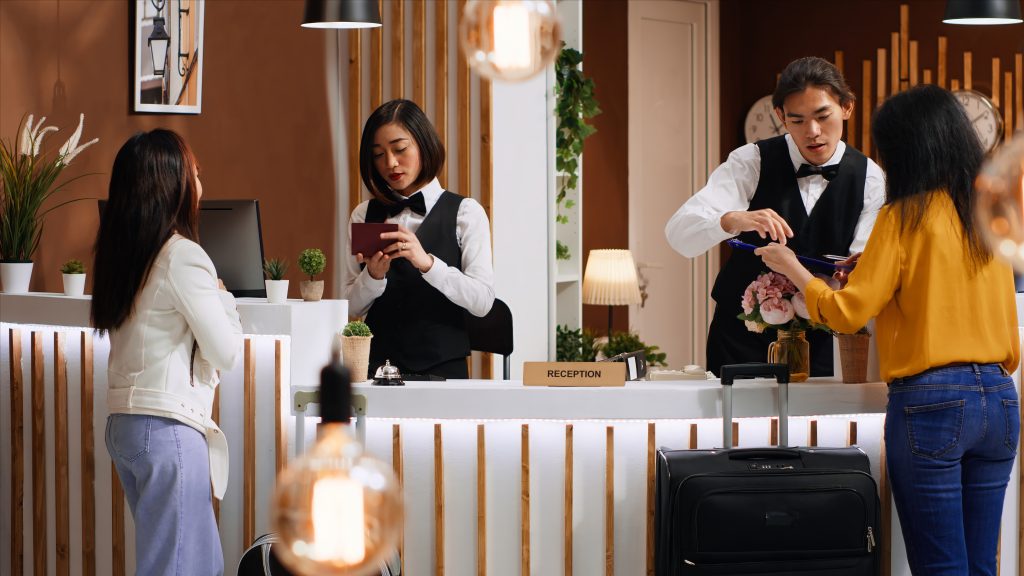
The front desk is where the guest is received, registered and assigned a room. It is here that he asks for information, for his key, his mail and finally for his bill.
The housekeeping department is under the supervision of a housekeeper. The housekeeper is responsible for the preparation of guests’ rooms and for the cleanliness of all public areas of the hotel.
The accounting department is responsible for all the hotel’s financial record.
Every hotel needs to record the income it receives. All room charges, the telephone, the laundry service, the restaurant and room service must be posted on the guests’ account as soon as possible. And the financial statements must be checked for accuracy.
The sales promotion of the hotel is another major administrative function. It involves making the public aware of the hotel and trying to attract guests.
Promotion can be done by advertising, which is paid promotion, or by publicity, and public relations, which are generally unpaid.
The engineering department is divided into heat, light, power, repairs, and maintenance, and is responsible for all the mechanical equipment.
The main task of the food and beverage department is to provide food and drink for the guests. Many hotels have complete restaurant services with different prices ranges and different menus. Some large hotels offer a variety of bars and restaurants for their guests to choose from. The income of the food and beverage department comes from sales and other services like banquets and conventions. (Source: Phumpanich & Sriatsadaporn, 2001: 30)
Group A
Group B
A. Housekeeping
B. Engineering
C. Front Office
D. Accounting
E. Food and Beverage
Theme: Hotel
Focus: Reading and Vocabulary
HOTEL TYPES AND DEPARTMENTS
Hotel types can be categorized depending on the criteria used to classify them such as hotel size, number of rooms, location, target market, ownership and affiliation, etc. Kate (2007:1) and Types of Hotels (2012:1) suggested types of hotels which can be classified into ten types according to specific purposes.
1. Commercial Hotels
These hotels primarily cater to business travellers and usually located in downtown or business districts. These are also known as Business Hotels.
2. Airport Hotels
This kind of hotels typically provides accommodation for airline passengers with overnight travel layovers or cancelled flights and airline crews or staff, usually located near the airports.
3. Suite Hotels
This type of hotels is the latest trend and the fastest growing segments of the hotel industry. It has a living room and a separate bedroom. Professionals such as accountants, lawyers, businessmen, and executives find suite hotels particularly attractive as they can also entertain in an area beside the bed room.
4. Extended Stay Hotels
This kind of hotels is similar to the suite hotels, but usually offers kitchen amenities in the room. It is for long-stay guests who want to stay more than a week and does not want to spend on hotel facilities.
5. Lifestyle/Boutique Hotels
This type of hotels gives guests a vacation setting with original decoration and service. The architecture of the hotel may be notable or the hotel has period furniture, artistic touches or other fetching themes.
6. Residential Hotels
These hotels provide long-term or permanent accommodation for guests. A guest usually makes a lease agreement with hotel for the minimum of one month up to a year. The room usually includes living room, bed room, kitchen, private balcony, washing machine, kitchen utensils, etc.
7. Resort Hotels
This type of hotels is usually located in the mountains, on an island, or in some other exotic locations away from the cities. Recreational activities, scenery, golf, tennis, sailing, skiing, and swimming are provided.
8. Casino Hotels
They are hotels with gambling facilities. Food and beverage operations are provided to support the casino operations in the hotels.
9. Conference and Convention Center Hotels
This type of hotels focuses on meeting and conferences and overnight accommodation for meeting attendees. The hotels also provide video conferencing facilities, audiovisual equipment, business services, flexible seating arrangements, flipcharts, etc. They are mostly located outside the metropolitan areas and have facilities like golf, swimming pools, tennis courts, fitness centers, and spas, etc.
10. Bed-and-Breakfast Hotels/Home-stay
This kind of hotels is a house with rooms converted into overnight facilities to accommodate one to ten guest rooms. The owner of the hotel usually stay on the premises and responsible for serving breakfast for the guest.
Theme: Hotel
Focus: Reading and Vocabulary
Read the text about hotel organization structure.
The larger the hotel is, the more complicated the hotel organization will be. In a small hotel, the operational system is simple and easy to run with one manager and one assistant. In a medium-sized hotel more staff are required and all the departments are independent of each other. Each department head reports directly to the manager. In the larger hotels, there is a greater level of professionalism in the different departments and sections. The management team under the general manager’s control will carry out the executive functions of the hotel, such as setting policy, budgets, long-term planning, sales plan and operating system. They are responsible for a larger staff and a far greater turnover.
The international hotel chains are under the control of a central management. The hotel services, operational systems and policies of the hotel chain are the same throughout the world. There is an inspection system in order to guarantee that overall standards are met. The key people like general manager and the department head are assigned from the headquarters. In addition, the staff members may take turns in working in other hotel branches throughout the world. The headquarters staff cooperate with other hotels in the same chain by giving advice and support about advertising. The most obvious advantage is the increased efficiency in making and controlling reservations. The great that one hotel can make his reservation for rooms at another within minutes.
TASK A
Directions: Fill in some missing parts in the blanks based on the above reading text.
The larger the hotel is, the more (1) ……….. the hotel organization will be. In a small hotel, the operational system is simple and easy to run with one manager and one (2) ……….. . In a medium-sized hotel more staff are required and all the departments are independent of each other. Each department head reports directly to the manager. In the larger hotels, there is a greater level of (3)……….. in the (4)………… departments and sections. The management team under the general manager’s control will carry out the executive (5) ………… of the hotel, such as setting (6) …………, (7) …………, long-term planning, sales plan and operating system. They are responsible for a larger (8) ………… and a far greater turnover.
TASK B
Directions: Fill in some missing parts in the blanks based on the above reading text.
The (1) hotel chains are under the (2) ………… of a central management. The hotel services, operational systems and (3) ………… of the hotel chain are the same throughout the world. There is an (4) ………… system in order to guarantee that overall (5) ………… are met. The key people like general manager and the department head are assigned from the (6) ………… . In addition, the staff (7) ………… may take turns in working in other hotel branches (8) ………… the world. The headquarters staff cooperate with other hotels in the same chain by giving advice and support about advertising. The most obvious advantage is the increased (9) ………… in making and controlling reservations. The great that one hotel can make his (10) ………… for rooms at another within minutes.